Monday, June 30, 2014

Moment of Inertia - Definition and Calculations

Definition

Moment of inertia, $I$, for a point particle of mass $m$ and distance $\rho$ away from the axis of rotation:
\begin{equation}
I = m \: \rho^2
\end{equation}
Note that $\rho$ is not the radial distance from the origin. It is the shortest distance from the axis of rotation. It is not the distance $r$ as in spherical coordinates, but it is the distance $\rho$ as in cylindrical coordinates. This forces me to write the volumetric mass density as $\varrho(r)$, which is commonly written as $\rho(r)$.

Descrete Collection

For a collection of discrete $N$ particles of masses $m_i$ and axial distances $\rho_i$ from the axis of rotation, the moment of inertial is given by:
\begin{equation}
I = \sum_{i=1}^N m_i \rho_i^2
\end{equation}

Continuous Collection

For a continuous collection of particles the moment of inertia is simply given by an integral over all the mass elements, $dm$:
\begin{align}
I &= \int_{V'} \rho'^2 \: dm
\end{align}
Note that the primes on $\rho'$ and $V'$ indicates that the integral is over the mass distribution. It is not a crucial thing here, but just a good notation system. Similar notation system is used in electromagnetism, where primes indicate location of charges and non-primes indicate the location of interest. For example $V(r)$ vs. $\varrho(r')$.

For 3D, $dm = \varrho(r') d^3r'$. For 2D, $dm = \sigma(r') d^2r'$. For 2D, $dm = \lambda(r') dr'$. So the moment of inertia changes appropriately. All these integrals could be evaluated in spherical, cylindrical or cartesian coordinates depending on the symmetry of the problem.
\begin{align}
I &= \int_{V'} \rho'^2 \: \varrho(r') \: d^3r' \label{Eq. 3D Cont I} \\
&= \int_{A'} \rho'^2 \: \sigma(r') \: d^2r' \\
&= \int_{L'} \rho'^2 \: \lambda(r') \: dr'
\end{align}
Once again, note that the $r$ is axial distance from axis of rotation and not radial distance from the origin.

Calculations

Solid Sphere

Consider a solid 3D sphere of total mass M and radius R of uniform density. First, we need to define the axis of rotation. Suppose z-axis is the axis of rotation.

Density can be found using total Mass divided by total Volume.
\begin{equation}
\varrho = \frac{M}{4/3 \: \pi R^3} = \frac{3M}{4 \pi R^3}
\end{equation}
Let's plug in this $\varrho$ into the moment of inertia equation, Eq. \ref{Eq. 3D Cont I}. We will evaluate this integral in spherical coordinates $(d^3r = r^2)$. The $\rho'$ is the axial distance from the z-axis, which is $r \: sin(\theta)$ in spherical coordinates.
\begin{align}
I &= \int_{r=0}^R \int_{\theta=0}^\pi \int_{\phi=0}^{2\pi} \Big(r sin(\theta)\Big)^2 \bigg(\frac{3M}{4 \pi R^3}\bigg) \Big(r^2 sin(\theta)\Big) dr d\theta d\phi \nonumber \\
& = (2 \pi) \bigg(\frac{3M}{4 \pi R^3}\bigg)  \int_{0}^R  r^4 dr \int_{0}^\pi sin^3(\theta) d\theta \nonumber \\
& = \bigg(\frac{3M}{2 R^3}\bigg)  \bigg( \frac{R^5}{5} \bigg) \bigg( \frac{4}{3} \bigg) \nonumber \\
& = \frac{2}{5} \: M R^2
\end{align}
The common mistake, a mistake that I make almost all the time, is forgetting to remember that the $\rho$ is the axial distance from the axis of rotation and not distance from origin. I have emphasized this point throughout this paper.

Note that it is easier to just remember a few of these equations than derive them. But, it is absolutely necessary to know how to derive them.

If you would like other examples worked out here, leave a comment below.

Friday, June 27, 2014

World of Fractals - Interactive Examples


Interactive Wolfram Demonstrations

Note: Click on the Play button on the top right corner to see the demonstration with any plugins. Also, some browsers might require your permission to display them.


Tree Bender from the Wolfram Demonstrations Project by Theodore Gray


Fractal Curves from the Wolfram Demonstrations Project by Roman E. Maeder


Thursday, June 26, 2014

World of Fractals - My Previous Work with Fractals


My Previous Work with Fractals

I have had the great opportunity to work on two projects on fractals for my Undergraduate courses. First was in Computational Physics course, where I wrote programs to generate beautiful fractals. I created both kinds of fractals using computer and learned an important concept in programming. Second was in Fourier analysis course, where I mathematically analyzed a special kind of fractals that could be analyzed with Fourier series. 

A collection of fractals that I have created in computational physics class with its significance is below. Programming fractals could be challenging, even impossible, without the use of recursion. Recursion is the process of repeating items in a self-similar way. For example, screen recording inside itself (see the image) or two mirrors in front of each other. In programming, this is done by a function calling itself.

Work from Computational Physics Course

Koch Curve. The following GIF image shows the fractal at each step of the recursion process. The function generating this fractal takes in a straight line as its input and turns it into "_/\_". It also sends each of the four segments of the new line into itself (Look at the image). After infinite steps, we would have the complete Koch Curve. This process keeps happening for some predefined number of times rather than infinitely many, because the time to execute increases very fast (n^n) with number of steps.


Sierpinski's Triangle. Like the Koch Curve, Sierpinski's triangle is also a geometric fractal and follows a simple rule. The animated version is given below.
Barnsley Fern. Statistical fractals also follow a simple rule, but they generate shapes via random numbers. Two of the same fractals won't have exactly same shape because of the inherit randomness. First let me show you the kind of fractals that can be produced using random numbers and simple rules.

Click on the Images to Expand them!
...

These fractals are a collection of points in 2D. We start with the root point $(x_n,y_n) = (0.5,0)$ and generate a new point $(x_{n+1},y_{n+1})$ using random numbers in a particular way. Schemes used to generate new random numbers is given below. It is really as easy as this. It takes a few lines of codes to create above fractals.

Algorithm for the first fern.
Algorithm for the tree.
I recommend that you take a quick look at my presentation for this course. Here are links to different versions: Mathematica CDFPDF.

Wednesday, June 25, 2014

World of Fractals - Introduction


Self Similarity in the Koch Curve.
Geometrical Fractal.

Introduction

My interest in fractals has continually grown over the past few years. I find fractals to be one of the most interesting and beautiful objects in Mathematics, and nature alike.

My knowledge on fractals is very limited, but, I have outlined what I know about fractals below. Please feel free to leave comments correcting my work, or adding to what I have to say.


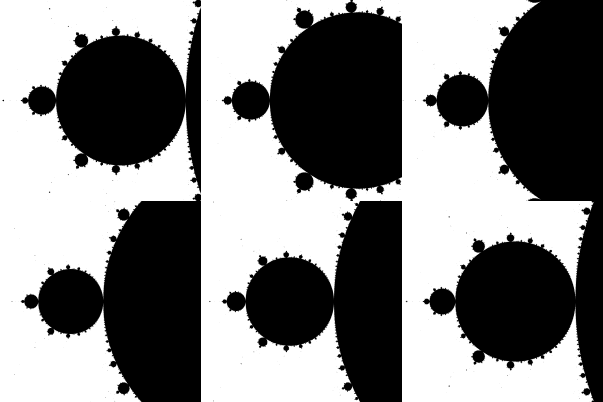
Self similarity in the Mandelbrot Set.
Geometrical Fractal.
Self Similarity
Fractals are objects that are self similar at all
scales. Look at the images of Koch Curve and Mandelbrot Set, the jaggedness of these objects look the same regardless of how much we zoom in.

Categories
I think all fractals can be characterized in two main categories, Statistical and Geometric Fractals. The Koch Curve and Mandelbrot Set on the right are both Geometrical Fractals. They have some definite shape, something that is not random. Statistical Fractals, on the other hand, do not have a definite shape. They are produced using random numbers and a particular algorithm. Their shape changes every time it is produced. One thing that is the same for both, is that they are all self similar at all scales. 

I have provided several examples of different fractals that I have created myself or found it online throughout this blog post.

Tuesday, June 24, 2014

Automated Screenshots in Mac

Taking screenshots every x seconds. 

  • Launch Terminal. It can be found in the applications folder.


  • Now, write one of the following code in terminal. First one will name files by time and second by number. 

  • Once you hit "enter", mac will start capturing screenshots every 8 seconds. 
  • Now, you can minimize terminal window, and start your work!
  • To Stop, bring forth the terminal window and press control+c.
Terminal after pressing control+c. 


Customizing:

Changing File Format. replace '-t jpg' with '-t pdf' or '-t tiff' or '-t png'. Also change $ \textrm{'\$vardate.jpg' to '\$vardate.pdf'} $  or appropriate format.

Changing Time. To take picture every 3 seconds replace 'sleep 8' with 'sleep 3'. (2 seconds or longer to avoid problems with naming).

Changing Save Location. Replace $\textrm{'~/Desktop/\$vardate.jpg' with '~/Pictures/ScreenShots/\$vardate.jpg'}$

Important Notes:

Dropbox's screenshot recording option could inturrept the this method. So it is advised that you quit Dropbox or other screen capturing services while using this. 

It is not convenient to take a selected window screenshot using this method. So, I recommend that you take full screen captures, and later use a tool like Photoshop to batch crop all the images. I will be writing a guide for that in future and update this blog with it's link.


Saturday, June 21, 2014

Bosons, the Saha Equation, and the Raman Effect

"Never accept and idea as long as you yourself, are not satisfied with its consistency and logical structure on which the concepts are based" - Satyendra Nath Bose

Bosons, the Saha Equation, and the Raman Effect

If you are an undergraduate physics student, then it is more than likely that you have heard of these words. Bosons are particles with an integer spin, while fermions are particles with half-integer spin; the Saha Equation is used in astrophysics to relate ionization state of different elements in a star; the Raman Effect is the phenomena where photons scatter inelastically off of atoms and molecules.

All of these physical phenomenas were developed by Indian Physicists: Satyendra Nath Bose, Meghnad Saha, and C. V. Raman. I encourage you to check out the documentary about these physicists (link below). It is very inspirational and informative.


The Quantum Indians Trailer. The full documentary is also available on YouTube.


Wednesday, June 11, 2014

Commutators in Quantum Mechanics


Quantum Mechanics

Particles are represented by a complex wave function.

Operators

Operators play a fundamental role in quantum mechanics. Operators are used to calculate the value of different observable quantities, such as position, momentum or energy of a particle. They are also used to calculate the evolution of the wave function in time. In a way, operators are used to access and modify the wave function. 

Uncertainties

A fundamental property of waves is that they do not have definite position and momentum at the same time. This issue translates to quantum mechanics as well. A quantum particle can't have all its observables definite. What does this tell us about the operators for these observables?

Commutators

The commutator of two operators can be used to learn about various properties.
1) The commutator of two operators, $[A, B] = AB - BA$, decides wether or not the two observables can be measured simultaneously. If two operators commute, $[A, B] = 0$, then the two corresponding observables can be measured simultaneously; and if they are nonzero then the two observables cannot be measured simultaneously. Moreover, the uncertainty in these two observables is related to the commutator.
$$ \Delta A \Delta B = \bigg | \frac{1}{2i} \Big \langle [A,B] \Big \rangle \bigg | $$

Sneak Peak

Stay tuned for more commutators!

Tuesday, June 10, 2014

Latex and Blogger


Adding Latex code to your individual blog. Simply copy the following at the beginning of your blog in HTML view. It is that easy.
Follow two simple steps shown in the images and Latex will be work with all of your posts without the need to add above code to every single Blog Post!
The required code is given below.

Important Note: the Latex code will not execute when you click preview blog. It will only work when you Publish the Blog. This is inconvenient, but works. I will post another blog if I find out a way to have it work in preview mode.

Monday, June 9, 2014

Welcome

First of all, welcome to our blog! We are an enthusiastic group of physics students. We are very motivated and eager to share our knowledge with you.

What to expect from us in the future?
  • Authors' Biography
  • A video series titled "AQC Physics"
  • Tutorials of all sorts
  • App reviews
Stay tuned.