Note: Click on the Play button on the top right corner to see the demonstration with any plugins. Also, some browsers might require your permission to display them.
I have had the great opportunity to work on two projects on fractals for my Undergraduate courses. First was in Computational Physics course, where I wrote programs to generate beautiful fractals. I created both kinds of fractals using computer and learned an important concept in programming. Second was in Fourier analysis course, where I mathematically analyzed a special kind of fractals that could be analyzed with Fourier series.
A collection of fractals that I have created in computational physics class with its significance is below. Programming fractals could be challenging, even impossible, without the use of recursion. Recursion is the process of repeating items in a self-similar way. For example, screen recording inside itself (see the image) or two mirrors in front of each other. In programming, this is done by a function calling itself.
Work from Computational Physics Course
Koch Curve. The following GIF image shows the fractal at each step of the recursion process. The function generating this fractal takes in a straight line as its input and turns it into "_/\_". It also sends each of the four segments of the new line into itself (Look at the image). After infinite steps, we would have the complete Koch Curve. This process keeps happening for some predefined number of times rather than infinitely many, because the time to execute increases very fast (n^n) with number of steps.
Sierpinski's Triangle. Like the Koch Curve, Sierpinski's triangle is also a geometric fractal and follows a simple rule. The animated version is given below.
Barnsley Fern. Statistical fractals also follow a simple rule, but they generate shapes via random numbers. Two of the same fractals won't have exactly same shape because of the inherit randomness. First let me show you the kind of fractals that can be produced using random numbers and simple rules.
Click on the Images to Expand them!
...
These fractals are a collection of points in 2D. We start with the root point $(x_n,y_n) = (0.5,0)$ and generate a new point $(x_{n+1},y_{n+1})$ using random numbers in a particular way. Schemes used to generate new random numbers is given below. It is really as easy as this. It takes a few lines of codes to create above fractals.
Algorithm for the first fern.
Algorithm for the tree.
I recommend that you take a quick look at my presentation for this course. Here are links to different versions: Mathematica CDF, PDF.
Self Similarity in the Koch Curve.
Geometrical Fractal.
Introduction
My interest in fractals has continually grown over the past few years. I find fractals to be one of the most interesting and beautiful objects in Mathematics, and nature alike.
My knowledge on fractals is very limited, but, I have outlined what I know about fractals below. Please feel free to leave comments correcting my work, or adding to what I have to say.
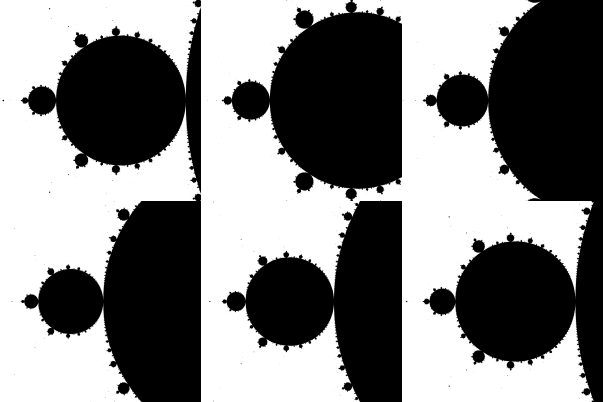
Self similarity in the Mandelbrot Set.
Geometrical Fractal.
Self Similarity
Fractals are objects that are self similar at all
scales. Look at the images of Koch Curve and Mandelbrot Set, the jaggedness of these objects look the same regardless of how much we zoom in.
Categories
I think all fractals can be characterized in two main categories, Statistical and Geometric Fractals. The Koch Curve and Mandelbrot Set on the right are both Geometrical Fractals. They have some definite shape, something that is not random. Statistical Fractals, on the other hand, do not have a definite shape. They are produced using random numbers and a particular algorithm. Their shape changes every time it is produced. One thing that is the same for both, is that they are all self similar at all scales.
I have provided several examples of different fractals that I have created myself or found it online throughout this blog post.